Showing posts with label East Sussex. Show all posts

Saturday, 3 July 2021

A Room of One's Own


Virginia's bedroom on the ground floor of Monk's House, where she used to write
before the tool shed in the garden was converted for her use

Hello!

This will be a relatively short post, as Kevin and I have just driven up to rural West Yorkshire for our first trip away since Christmas last year, braving the Delta variant that surrounds us on all sides in the larger towns and cities of the north-west of England. 

The day before we left I drove over to the tiny village of Rodwell, near Lewes in East Sussex, to visit the National Trust property Monk's House. Having ticked off all the Jane Austen sites on my list, I thought it was about time I reactivated my work on the list for another of my favourite authors, Virginia Woolf.


Virginia Woolf photographed by Ottoline Morrell in 1924 
© National Portrait Gallery, London

Some years ago we visited Charleston (not far from Monk's House), the home of Virginia's sister Vanessa Bell. I have also wandered the streets of Kensington and gazed up admiringly at the elegant London townhouse at 22 Hyde Park Gate, where Virginia and her brother Adrian lived for some years after Vanessa married Clive Bell. However there are still a couple of properties to be visited.

I have read, and re-read, all of Virginia's novels and essays many times and most particularly Orlando, which is up there with Austen's Pride and Prejudice as one of my favourite novels. I was skeptical when Sally Potter's 1992 film adaptation came out but I needn't have worried; I mean, *Tilda Swinton* - the perfect embodiment of Virginia's gender-swapping hero/heroine. It is sublime. I saw it at the cinema three times and have my own copy on DVD. I've lost track of the number of times I've watched this glorious film.


The visit to Monk's House required me to take time off work, because the National Trust, in its wisdom, has decided they will only open Monk's House to the public for a few hours on Wednesdays and Thursdays. Fine if you're a retiree or somebody of independent means. Those of us struggling away on mediocre salaries are obliged to use one of our precious days of annual leave to visit. Additionally, they have only opened up the ground floor of the cottage. 

The village of Rodmell is lovely, with picture-perfect cottages and larger houses, horses clip-clopping along its narrow lanes, and views over the open East Sussex countryside, to the surrounding chalk hills.


One of the nearby cottages in the village of Rodmell


The Old Rectory, just down the lane from Monk's House


Deep Thatch Cottage, where you can purchase eggs from their chickens at the front door,
also just down the lane from Monk's House


Cute little window display in a cottage in Rodmell


Rampant wisteria and climbing roses adorn this cottage almost opposite Monk's House


St Peter's Church, onto which Monk's House backs.
It dates from the 12th century and is one of the earliest surviving examples of
Norman architecture in England


The flint and brick walls in the village are possibly held together by the
plants that have miraculously managed to grow through them!


Monk's House itself is a thoroughly charming and cosy dwelling, which was the country home of the Woolfs for over 20 years. Parts of the building date from the 16th century, but it has been added to over the centuries and the Woolfs renovated extensively, adding an upper level and extending the ground floor. 

Most of the furniture on display is original, purchased by the Woolfs on jaunts abroad and closer to home. And just as you would expect, the walls are filled with artwork by their intimate circle of artistic relatives and friends. The Bloomsbury style is not necessarily an aesthetic I would choose for myself, but when you visit Charleston and Monk's House the mad, crowded designs have huge and fitting appeal. For The Bloomsbury Set art was not just for pictures on the wall - the walls, ceilings and floors were adorned with patterns and colours, furniture was decorated, busts were sculpted, pottery was made. It was a genuinely artistic and unconventional life for this group of people, celebrated via paint, pencil, clay and literature.

Many renowned artists and writers regularly visited the Woolfs at Monk's House including T S Eliot, E M Forster, Roger Fry and Lytton Strachey. 


Steps leading up from the sitting room to the lean-to conservatory


After Virginia's death Leonard continued to live in the cottage, joined by his new partner Trekkie Parsons, and there is abundant evidence of her artistic talent. Monk's House therefore is not a perfectly preserved shrine to Virginia, however I felt her presence in each of the rooms we are allowed to view and most particularly in the little ground floor bedroom (first photo in this post) which has a separate entrance to the rest of the house. It was here Virginia used to write before the tool shed at the bottom of the garden was converted for her into The Writing Lodge, in 1921. Virginia's bedroom is a light-filled and soothing space, continuing her preferred décor which incorporates many shades of green.

The house was described by Leonard as having a 'ramshackle informality,' with books, magazines and newspapers scattered on tables, chairs, floors and even up the staircase, and dog and cat bowls in various locations.


The moody and welcoming sitting room with its myriad shades of green.
This part of the house dates from the 16th century


More shades of green in the sitting room! A cosy nook in front of the fireplace


The intimate dining nook - only room for six guests


Stairs to the upper level, added by the Woolfs


The rear of the house, with Virginia's bedroom wreathed in climbers, behind the delphiniums


The Writing Lodge, converted from a toolshed for Virginia's exclusive use


Kitchen cupboard painted in the Bloomsbury style by Trekkie Parsons

Virginia apparently took much joy in the garden and indeed, it's beautiful - with a number of separate walled / hedged garden 'rooms' inviting quiet contemplation, an orchard and a couple of ornamental ponds. I visited Rodmell in peak bloom, in early summer when the entire village was heavy with the scent of roses, honeysuckle and lime trees.


Looking over the Italian Garden towards the rear of the house


Bust of Virginia on the wall that divides the Fig Tree Garden from the Piggery Pond Garden


The edge of one side of the garden, with far-reaching views across the East Sussex countryside


Roses at the entrance to a cottage just up the lane from Monk's House


Ms Woolf is acknowledged as 'not an easy read' and I understand why her literary style is not to some people's taste. By all accounts she was a highly complex character and her struggles with depression (most likely bipolar disorder) and anorexia are well documented. I don't think too many people would have been shocked by her suicide in 1941. At the age of 59 she filled the pockets of her overcoat with heavy stones and walked into the River Ouse not far from Monk's House.

But oh, what an exceptional woman! Ahead of her time in many respects and not least as one of the foremost feminist authors of the 20th century. Published in 1929, A Room of One's Own is an essay which decries the role of women solely as partners and child bearers, and defines an almost ridiculously simplistic but insightful edict that:

"A woman must have money and a room of her own if she is to write fiction."

Almost a century later, not much has changed. 

Women with literary ambitions still struggle against the social pressure to focus on career in conjunction with or as an alternative to a life dominated by partner or family. Thank goodness Virginia found Leonard who, by all accounts, was her greatest champion, and with whom she jointly established The Hogarth Press in 1917. Without his support she probably never would have been published, and the literary world would be an infinitely less interesting place.


First edition cover of A Room of One's Own, published by the Hogarth Press

Until next time,

- Maree  xo


Sunday, 18 October 2020

Rambling Around Rye


Famed Mermaid Street in Rye


Well, here we all are. Still labouring under the weight of the pandemic.

In anticipation of another lockdown, or at the very least a tightening of restrictions on movement, last week I took myself off towards the East Sussex coast for a couple of days.

I had the leave from work booked already - the deferral of my trip to Bruges that should have occurred in March, but was moved to October in the hope that the world might have returned to some kind of normality by then. Ha!


The Landgate (dating from 1340) is the only survivor of four gateways to the town.
The portcullis was removed in 1735


All along the southern side of the town, which is perched high,
are narrow steps leading down to the land between the Rivers Rother and Tillingham


I should state up-front that I knew absolutely nothing about Rye prior to driving there. My interest had been piqued in a vague kind of way over the years by various pieces of literature and their film interpretations. 

Firstly, Cold Comfort Farm by Stella Gibbons, which novel I have read and re-read multiple times, not to mention countless viewings of the film adaptation featuring a very young and sometimes half-naked Rufus Sewell *swoon* (if you're interested, a fan has put together 3 minutes and 32 seconds of Rufus from the film, set to Adam & The Ants' Prince Charming - here). The dialects featured in both the novel and film are influenced by East Sussex, and the chapel scene in the film, featuring Ian McKellen's mad preacher, was filmed in a chapel in Rye. 

Secondly, I'm a great fan of the Mapp and Lucia books by E F Benson. The author lived in Lamb House (now a National Trust property) for a number of years, and his fictional village of Tilling is a thinly-disguised Rye, right down to the crooked chimney mentioned many times in the books. I adored the 2014 BBC TV adaptation starring the always wonderful Anna Chancellor, Miranda Richardson, Steve Pemberton and Mark Gatiss, and I've stumbled across a website that appears to let you view at least the first episode for free - if you are interested, hopefully you can access it here. It was filmed extensively in Rye.


The house with the crooked tower, which features in the Mapp and Lucia novels


The same building was the home of Henry James for nearly 20 years from 1898, and it was here he wrote some of his best work, including What Maisie Knew and The Golden Bowl. Many renowned authors visited him over the years, including Rudyard Kipling and H G Wells.

Just my luck, Lamb House remains closed due to the pandemic so all I got to see was the garden wall and front entrance.


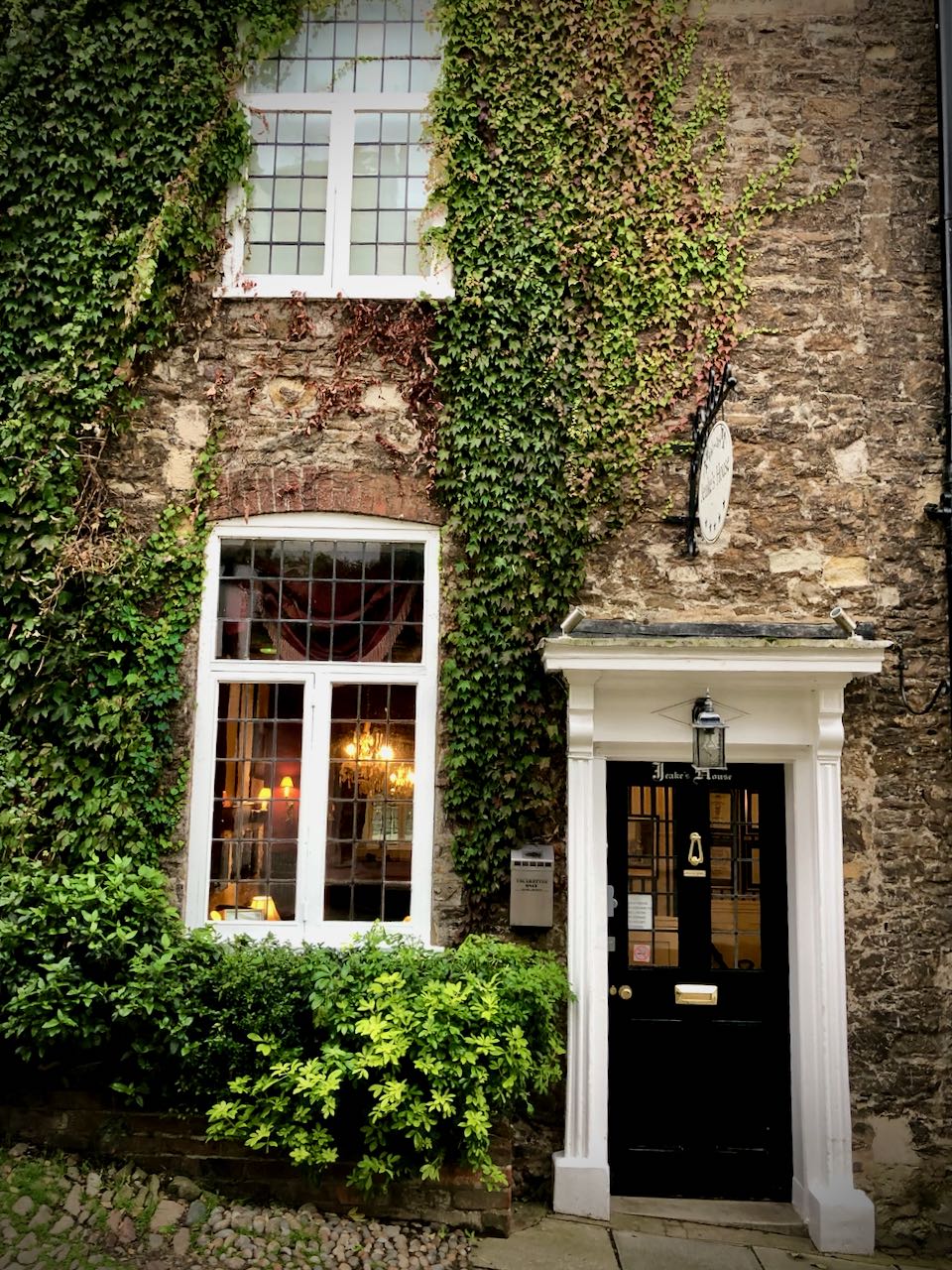
But it was an email from Sawday's last year, advertising a luxury B&B in Rye, that drew me. Jeake's House is situated in Mermaid Street - probably the most photographed spot in Rye with its cobbles, quaint cottages and 15th century pub.

Sadly Jeake's House had no vacancy, so I ended up staying in an acceptable B&B (actually more like a little boutique hotel) in the high street. 


Jeake's House in Mermaid Street, where there was no vacancy  :-(


The Mermaid Inn in Mermaid Street - 're-built' in 1420!!!


The Mermaid Inn


Thank goodness I was wearing boots with thick soles - those cobbles are murder to walk on!


Mermaid Street at sunset


'The House Opposite' (opposite The Mermaid Inn)


Decorative semi-circle bay window on Mermaid Street


What a delight this town is! 

It has a very rich history, being only 30 minutes' drive from Hastings, and because of its maritime connections. Whilst the town itself is no longer right on the coast (it was almost surrounded by the sea in mediaeval times, but the sea has now retreated), the Rivers Rother and Tillingham meander through it on opposite sides and Rye Harbour is 5-10 minutes away. Smuggling was rife through the centuries, and much of the traditional local vernacular - sadly being lost in our modern age - stemmed from that occupation, some being local interpretations of French words, for example Boco - meaning 'much' and originating from the French beaucoup. There was a cross-channel service to Dieppe for centuries.

Some of the houses also have 'smugglers' windows' - tiny windows at each end of the house, up high, wherein a lighted candle would be placed to indicate that the coast was clear for the transportation of illicit goods. 

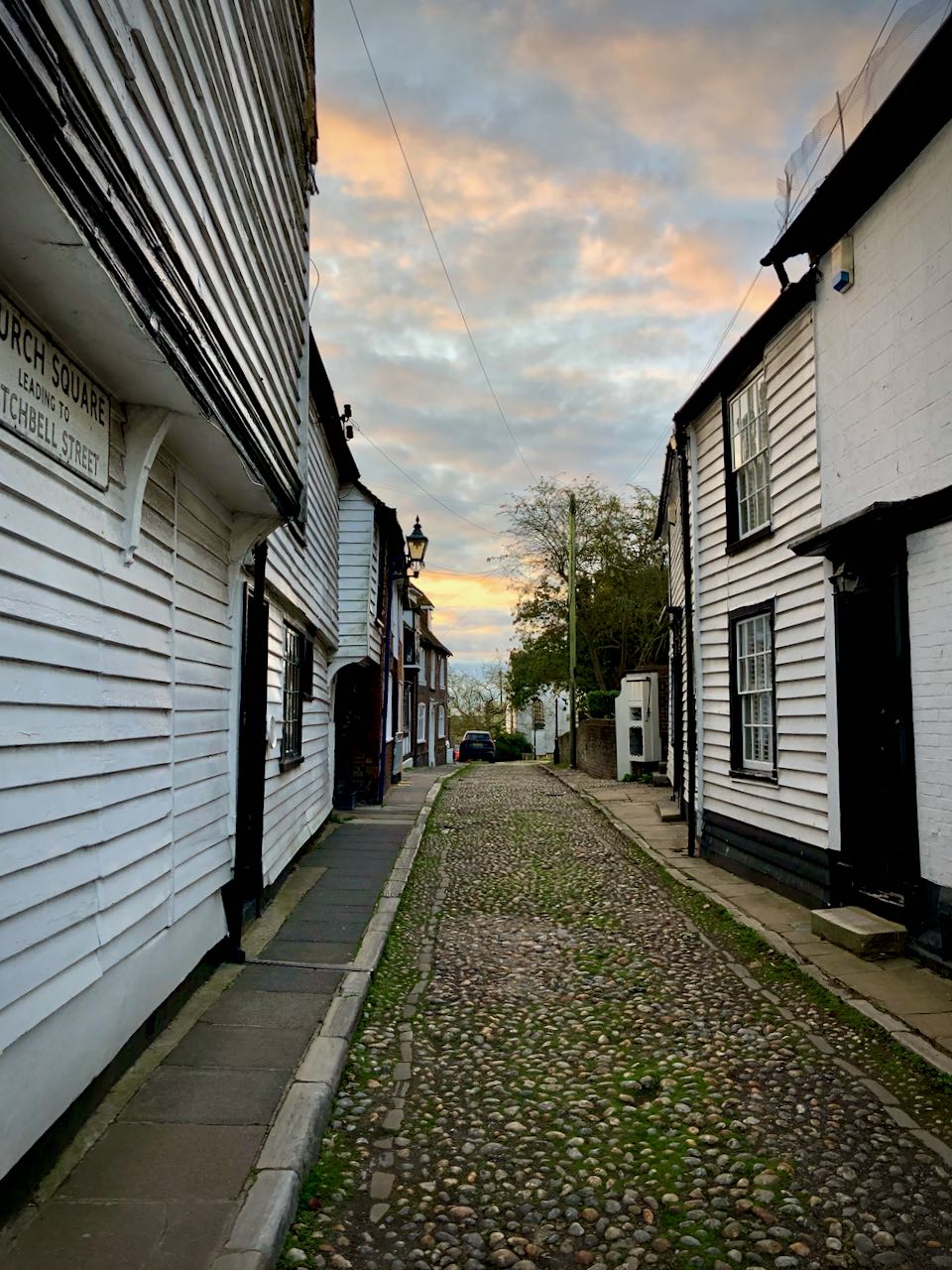
Tiny, winding streets are filled with houses from various centuries, many of them constructed from white clapboard which gives the town a fresh, coastal look. I spent hours just strolling around being a sticky-beak, admiring people's cosy little homes.


Cobbles and clapboard


Another beautiful house in Mermaid Street


Many of the houses in Rye have gorgeous little lanterns at their front entrances


Half-timbered house on the corner of Church Square and Watchbell Street


This is a B&B - you can stay here!
(https://ryewindmill.co.uk/)


The commercial buildings of Rye are also very appealing, and there's a pleasing number of cafés, antiques stores, small art galleries and providores of local foods.


The rear of the Town Hall


This shrub adorned the front wall of a café in the High Street.
I've never seen anything like it before - the bubblegum colours on those berries... they don't look real!
(my botanical guru, Lesley Williams, tells me it's called Porcelain Berry)


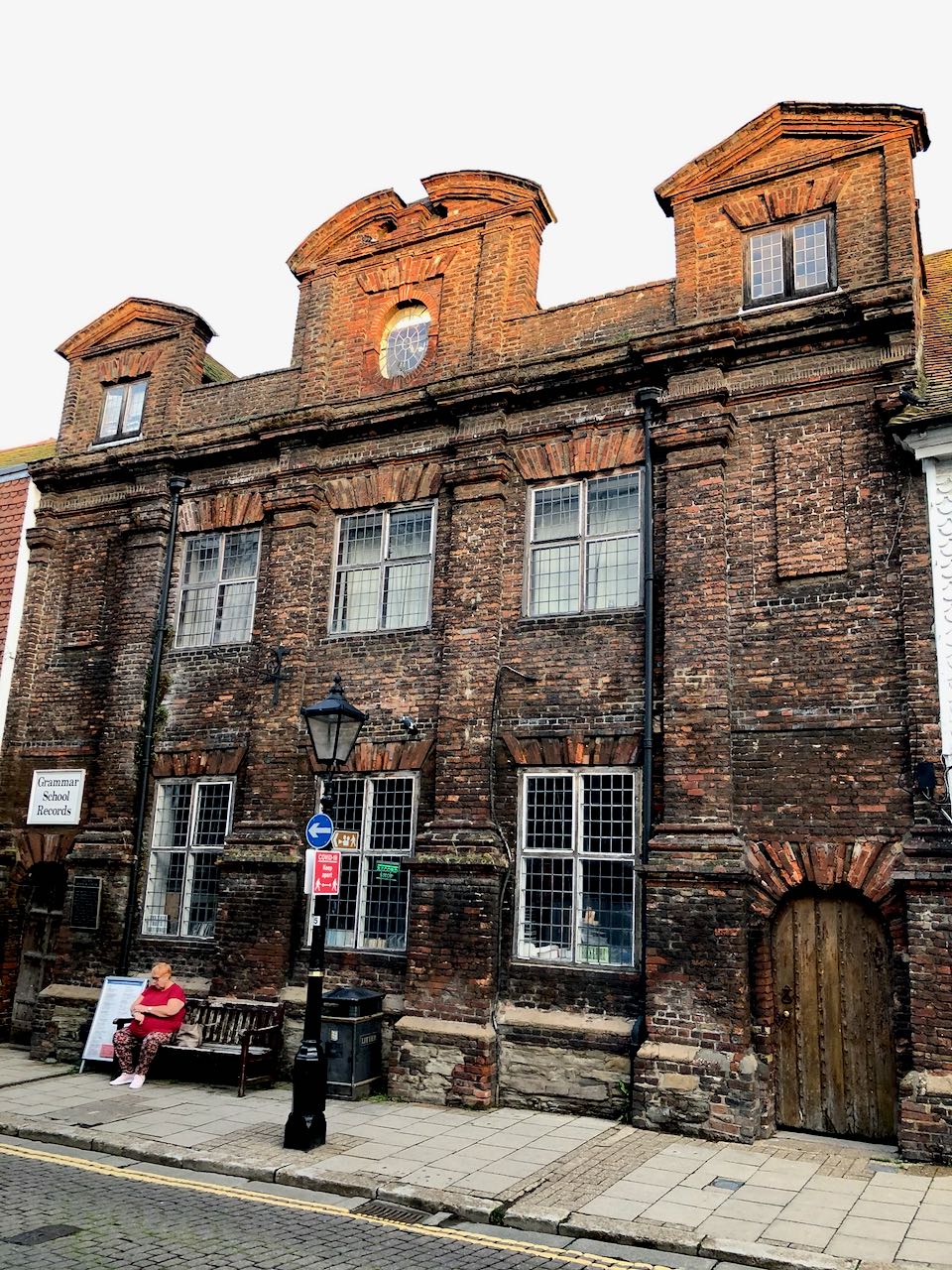
The old Grammar School, constructed around 1633


How groovy is this mid-century salesroom?
This is just one room in a labyrinthine antiques centre near the Strand Quay on the River Tillingham.
I managed to kill an hour here!


I purchased a walking guide to Rye from the Town Hall tourist information nook, and was horrified to read of various gruesome episodes in the town's history, including a monk who had an illicit affair with a young local girl and was bricked up alive in a wall of the Friary by his brethren (15th century), and a customs officer who was buried alive by a smuggling gang (18th century).

Sadly, the Ypres Tower was not open to visitors (another victim of COVID), so I had to make do with admiring its exterior and then enjoying a mid-afternoon late lunch at the Ypres Castle Inn - only my third experience of dining out since March this year.


The Ypres Tower, dating from 1250. 
Originally a defence against invaders at the time when Rye was surrounded by sea,
it's since been a prison, a courthouse, a mortuary and even a private home for a time


My mid-afternoon lunch venue


If I was going to risk exposure to Coronavirus dining indoors, it had to be worth it!
Delicious warm winter salad with a side of skin-on fries, and a glass of Prosecco


On my first morning I walked out to Camber Castle, about 3.5 kms from where I was staying. I'd woken early and chosen to have breakfast at the socially-distanced / staggered time slot of 8:00am, and most of the shops didn't open until 10:00am, so it was a way of filling a couple of hours. You guessed it, folks - closed due to COVID. All the same, it was a glorious autumn morning and I enjoyed the exercise.

Walking out to Camber Castle, with the town of Rye just visible in the top left-hand corner


Alliteration in action: Camber Castle. COVID. Closed.


I highly recommend a visit to this lovely town if you're ever in East Sussex, and I'd happily return. It's only 30 minutes from Hastings, so if you're interested in English history it's a very rewarding part of the country.


Rye at dawn


Sunrise over the River Rother - taken from the Ypres Tower 


After checking out and about to make my way back to Surrey, I took a short detour to Camber Sands, about 10 minutes' drive east from Rye. I felt obliged to so, as the tour guides (and several of my work colleagues) raved about it being a beautiful beach, and it's the only sand dune system on the East Sussex coast. However, I had low expectations, having visited supposedly 'beautiful' sandy beaches in southern England previously.

I'm afraid Australians have different standards when it comes to the quality of beaches. My low expectations were met, and I'll just leave that there - you can judge for yourself from the photos below. Bear in mind you're probably seeing the beach at its best, at around 9am in early October. Imagine it thronged with 25,000 people (that's how many flock there on a really hot day).

Camber Sands.
Fancy a dip? Take a packed lunch. It's a looooooong walk before you reach the water


My attempt to make Camber Sands look appealing


En route to Rye I had made a stop at National Trust property, Bateman's, the former home of Rudyard Kipling. A nice enough property, but sadly only the ground floor of the house was open to the public, with the excuse that 'the upper floor was not easily able to be sanitised' ??? Hmmm... or the National Trust can't be arsed spending the money to do it. That might sound harsh, but we and numerous of our friends have had less than favourable experiences with the National Trust administration this year, and there are whispers that they have no intention of reopening many of their houses, and have treated many of their employees with disdain during the pandemic. It's an organisation that relies heavily on volunteers, and it was news to me to find out that a good proportion of their paid workforce are on zero-hours contracts. 

The National Trust is a charity and I understand times are tough, but as a member I'm paying for access to the houses primarily. Yes, I also enjoy the grounds and the non-building NT sites, but it's the houses that really draw me. If I'm to be unable to visit a large proportion of the buildings, I'm going to reconsider my membership.


Bateman's, former home of Rudyard Kipling (now National Trust).
 Entry to the house, on the eastern side


Close-up of the entry


Gilt painted leather wallpaper in the dining room of Bateman's


Oast house with dovecote, at the rear of the main house - Bateman's


The pond at Bateman's


Rear entrance to the house, facing the pond - Bateman's


We continue to take brief jaunts in various directions from home, usually no more than an hour's drive away, exploring the plethora of beautiful villages and gorgeous countryside. Last weekend we ventured to the hamlet of Halnaker in West Sussex, just north of Chichester and about 45 minutes by car from home. The drawcards were Halnaker Windmill and the 'tunnel' leading to the windmill - an avenue of trees that encircle the walker. 

On the advice of other walkers we parked in the nearby village of Boxgrove and walked for about 20 minutes, crossing fields and passing Tinwood Estate Vineyard before reaching the farm on whose land both the tunnel and windmill are sited. 

It was a glorious autumn day, but we've decided the ideal time to visit would be at about 5pm in mid / late October which should be peak autumn colour - so that the low sun illuminates the tunnel, and because there are likely to be fewer visitors at that time of day. We're hoping for the right weather conditions in the next week or so, for a return visit.


An avenue of trees with Tinwood Estate vineyard on the left, and grain fields on the right


Vines changing colour - Tinwood Estate Vineyard, north of Chichester, West Sussex


Halnaker Tunnel, leading to Halnaker Windmill, West Sussex


Another section of Halnaker Tunnel, autumn colours starting to show


Halnaker Windmill, West Sussex


Yours truly + Kevin at Halnaker Windmill


Halnaker Windmill in the afternoon sun - just north of Chichester, West Sussex


As usual, I'll end my post with a few shots of the changing seasons in our local area. It is, of course, my favourite time of year - glorious Autumn. 


One of my favourite local houses - Spreakley Hollow, near Frensham village


House in Spreakley, near Frensham village


Autumn colours at Pitt Farm, Spreakley (about 30 minutes' walk from home)


Golden Clematis - having pass through the yellow flower stage,
and now transforming from silky seed-head to fluffy last hurrah


Frensham Heights (ie home) looming majestically above the landscape in Gothic Revival splendour


Autumn sunset from our backyard - mid October

Until next time,

- Maree  xo