|
| Picturesque Sandøy, one of the islands in the Ålesund municipality, Møre & Romsdal Country, Norway |
Well, greetings from the apocalypse. At least, that's what it feels like, with the UK experiencing its hottest and driest summer on record, fires in multiple locations and the entirety of England and Wales officially in drought.
I am utterly miserable.
Anyway, more on this sorry state of affairs a bit later...
I'lll start this post by explaining why, despite quite a bit going on over the past 2-3 months, Tunnels of Green has been silent.
 |
| Yours Truly, sporting the latest in fracture-wear fashions. Not really a lot of fun during consecutive record-breaking heatwaves |
The above picture, folks, is my right arm encased in plaster. I managed to sustain my first ever broken bone whilst visiting Norway for a family wedding, and not only did I break my distal radius (wrist) but I also dislocated it. I never do things by halves. Believe me when I tell you that I never, ever again in my lifetime wish to experience anything like the process to re-set the bone. It was truly horrific.
I was in plaster for five weeks, then in a splint for a further week or two, and for the past four weeks I have been assiduously performing a range of painful physiotherapy exercises in an attempt to get these ancient muscles and tendons to function again. On sustaining the fracture I was unable to cut up my own food, write or even tap out more than a few words on the laptop - this state of affairs lasted about eight weeks. Thankfully, I am now able to do these things in short bursts, though it still hurts. It is very slow progress, and I have been told that it will likely take a full year for the healing to complete... but that I might never recover all the strength and flexibility in my right hand. So there's that.
Anyway, enough said about this unhappy business, and onto the more pleasant part of our time in Norway back in early June.
 |
| View from the sitting room window in the old wing of my cousin's home |
We were delighted to be invited to the wedding of my cousin's younger son Jørn and his lovely partner Merete, both of whom visited us at Frensham back in 2024. They are a gorgeous couple and we felt very privileged to share this important moment in their lives.
Central Norway put on glorious early summer weather for the event, which started with a ceremony in the 800-year-old Romanesque church in Tingvoll and continued with a reception in the local village hall.
Champagne and canapés outdoors were followed by two courses of excellent food inside the hall (a main course and dessert), after which the speeches were given. The next stage was something apparently confined to that particular region of the Norway, The Cake Table, because clearly one lot of dessert was not enough. It had to be seen to be believed! Next we were entertained by a local musician who played guitar and sang a mix of traditional folk tunes and songs about the local area. Then it was time for games (!), followed by the bridal waltz and general dancing, at which point we expected things would wind down.
How wrong we were...
 |
| Ladies, Gentlemen and Non-Binary Persons, I give you THE CAKE TABLE 😮 |
At around midnight I spied the groom's brother scurrying back and forth outside the hall, in the Norwegian evening summer light (it never gets truly dark in summer, even down in southern Norway), rearranging the outdoor picnic benches and tables with the assistance of a few strapping friends. What on earth could be going on at this hour? I wondered. Surely they're not starting the clean-up with a hall still full of guests in attendance?
Nope. It was time for 'midnight food'. Seems those practical Norwegians understand that when the wedding supper has been served just a couple of hours into proceedings, by the time the speeches, entertainment, games and dancing have taken place, people will be hungry again. And they plan for it. So there we were, close to a hundred people lining up for a barbecue in the small hours, with no sign of festivities concluding anytime soon.
Reader, this wedding reception started at around 1pm on Saturday and was still going strong when Kevin and I departed - defeated! - at close to 2am on Sunday morning. Norwegians know how to party.
I'm not publishing any photos of the wedding other than the one above, but take my word for it that this was a highly successful event. Jørn and Merete's friends are all delightful, gregarious people, and I even got to meet some more Sami relatives from another branch of the family, who had flown down from Finnmark for the occasion.
We stayed on with Marion and Erik for another six days after the wedding, and as always we were treated to day-trips exploring the seemingly never-ending attractions that lie within a couple of hours of their home. I suppose someday we'll have seen it all, but not yet!
Ou first excursion was to Todalen (the To Valley) via road and car ferry, where we did a leisurely walk from an ancient farm to the Naustå Waterfall. Not another soul around the entire time; we had the whole place to ourselves.
 |
| Todalen Church, about an hour's drive from Marion and Erik's home. It's not terribly old, built in 1861, but very charming and what a setting! |
 |
| Interior of the Lutheran church in Todalen, Møre & Romsdal County in Norway |
 |
| Marion, Erik and Kevin en route to Nauståfoss (Naustå Waterfall) in Todal, in the mountainous Trollheimen region of central Norway |
 |
| Nauståfoss (Naustå Waterfall) which has a height of 140 metres |
 |
| Lupins by the river at Todalen |
 |
| We met these friends on our walk to the waterfall at Kårvatn Fjellgård in Todalen |
 |
| Gorgeous house in Todalen, on our way to Kårvatn Fjellgård, where the walking trail to Nauståfoss starts |
A couple of days later we drove an hour or so to Aukra where we parked the car and joined a local ferry service. It does a loop multiple times each day - basically it's the equivalent of a local bus service! Like all Norwegian public transport the fully electric ferry was pristinely clean, with very comfortable seating and tables, and a pay-by-card, self-serve refreshments nook where you could purchase drinks, snacks and brewed coffee.
For several hours we floated around, taking in the magnificent views and watching passengers board and alight from various picturesque island hamlets in the Norwegian Sea, just off the west coast of central Norway (next stop westward is the Faroe Islands). What did this activity cost? Zero. Zilch. Nada. That's right, Reader. Foot passengers pay nothing on these local commuter ferries. The civilised Norwegian government considers that people living in less populous areas shouldn't be financially penalised just because they choose to live somewhere slightly remote.
 |
| View from the stern of our ferry as we toured around the islands off the west coast of Norway, near Ålesund |
 |
| Chain of mountains in the distance, pristine waters in the foreground - viewed from the free ferry service |
 |
| Information board for 'Øyriket' (the Island Kingdom) . We floated around these islands for several hours on a free ferry! |
And of course, as always we enjoyed spending time in Marion and Erik's beautiful village, which was looking absolutely resplendent in full summer foliage. The days were relaxed, and punctuated by Marion's superb cooking. We look forward to returning the favour when they visit us in Ledbury, in late September.
 |
| A bit of grey sky, but summer meadows in full bloom! The view from the hill above Marion and Erik's house in Gyl, Norway |
 |
| Summer abundance in evidence in central Norway |
Here on the home front, the past couple of months have been made infinitely more enjoyable by the presence of dear friend Lesley, back in the UK after a two-year gap. She has merrily made her way across England and Wales, undertaking pet-sitting assignments in various beautiful locations.
It was wonderful to spend so much time with Lesley over the span of her time here. Fortunately, in addition to staying in our house on a couple of separate occasions, two of Lesley's sits were within an easy drive of our house and we took the opportunity to meet up for days exploring castles, gardens, historic houses and pubs.
As ever, Lesley was far better informed about some of the attractions within an hour or two of our newly adopted location, and we were lucky to schedule activities on days that were only moderately uncomfortable for me, instead of impossibly hot.
Our first meet-up was just over the border into Wales, in the beautiful Wye Valley, primarily to take a look at Tintern Abbey which sits on the banks of the River Wye. This ruined abbey was founded in 1131 - the first cistercian abbey in Wales, and the second in Britain after Waverley Abbey near Farnham (which was a 10-minute drive from Frensham; we visited regularly). Over the past hundred years, particularly, there has been considerable work to reconstruct parts of the building.
Whilst in that neck of the woods, we took the opportunity to nip over to Chepstow, an historic town further along the River Wye with winding streets and pretty coloured terraced houses. The castle is often cited as the oldest surviving stone castle in Britain.
 |
| Lesley and Kevin in front of Tintern Abbey, Monmouthshire, Wales |
 |
| Chepstow Castle, Monmouthshire, Wales |
 |
| A row of coloured terraces in Chepstow, opposite the castle |
 |
| St Mary's Priory Church in Chepstow, with its Norman (12th century) entry. Other parts of the building have been re-built or replaced over the centuries |
Although Lesley had been to Hellens Manor in Much Marcle some years ago, one afternoon she and I decided to take another look at the gardens although, as anticipated, they were looking slightly worse for wear in the harsh summer conditions. Hellens is only 10 minutes from our house in Ledbury and Kevin and I have visited multiple times, including attending a Scandinavian music recital one evening last winter.
It is a gorgeous property, and the house tour is well worth doing too.
 |
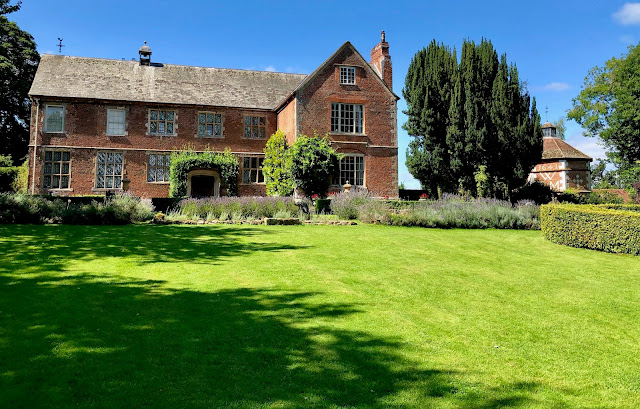
| Entrance to the house at Hellens Manor, Much Marcle - a mere 10-minute drive from home |
 |
| The Dovecote at Hellens Manor, Much Marcle, Herefordshire |
 |
| I want this lovely thing for my garden! Delicate summer blooms (Astrantia Major - with thanks to Lesley Williams for identifying!) at Hellens Manor, Much Marcle |
 |
| I have no idea where I took this photo! Clearly inside a church? 🤣 |
Lesley and I also spent a couple of days exploring previously undiscovered places of interest in the nearby Cotswolds.
Stanway House near Toddington in Gloucestershire is a lovely Jacobean manor house (late 16th century) constructed of that beautiful, golden Cotswolds stone but made unique by the fact that the grounds host the tallest gravity-fed water fountain in Europe! It was only installed in 2004 and is fired up a couple of times each day, to the great delight of visitors in hot summer conditions. The house itself has been used as a filming location for a number of TV series and films including Jeeves and Wooster, Vanity Fair, Father Brown and Wolf Hall.
We also did a private group tour of Owlpen Manor near Uley, also at the Gloucestershire end of the Cotswolds, followed by afternoon tea with scones, jam and cream. The house is a Tudor manor originally constructed in the 15th century, and to get there you have to bravely drive a long a very long, winding and extremely narrow road, praying all the time you won't meet a vehicle coming from the opposite direction! The current owner of the property and his son were our hosts for the official tour of the house and gardens, and they were charm itself, although I was quite shocked to discover some days later that the house has been used as a filming location, including for the superb film Phantom Thread (2017) starring Daniel Day Lewis, Vicky Krieps and Lesley Manville. Why on earth this juicy little tidbit was not included in the tour, I cannot fathom.
Owlpen's Church of the Holy Cross (constructed 1828-1830), which is accessed via a gate immediately behind the house, was also mentioned only in passing by our hosts. However, neither Lesley nor I have ever been known to pass up a church inspection. We were astonished at the lack of enthusiasm for this gorgeous gem of a place - we quite literally gasped with delight as the door opened to reveal an elaborately decorated building including walls covered with inlaid mosaics by Powell of Whitefriars Glass Works (Arts and Crafts! Swoon!). The baptistry had a gilded, vaulted ceiling, stained glass windows and a Norman font. We were happy as pigs in mud.
 |
| The magnificent tithe barn at Stanway House, Toddington (Cotswolds) has been standing since 1370 |
 |
| Teacup display in the window of Stanway House's tearoom. I'll have the gorgeous little number in cerulean blue, thanks ♥️ |
 |
| The rear of Stanway House, Gloucestershire (Cotswolds), facing onto the lawn. Constructed in that unmistakable golden Cotswold stone, it's a Jacobean manor house dating from the late 16th century |
 |
| This gorgeous thing is the gatehouse at Stanway House near Cheltenham. It was built around 1630 |
 |
| View of the formal gardens and the house at Owlpen Manor in Uley, Gloucestershire. You can just see the tower of the Church of the Holy Cross, to the upper left of the house |
 |
| Steps leading from the terraced gardens up to the house at Owlpen Manor, Gloucestershire |
 |
| The Baptistry at Owlpen Manor's Church of the Holy Cross - Uley, Gloucestershire |
 |
| The vaulted and gilded ceiling of the baptistry, with incredible Arts and Crafts inlaid mosaic walls - Church of the Holy Cross at Owlpen Manor near Uley (Cotswolds) |
 |
| Lesley and I, stuffed full of scones with jam and cream, in front of the biggest (and perhaps oldest?) cider press you have ever seen - at Owlpen Manor, Cotswolds |
Once again it was terribly sad to bid farewell to Lesley as she headed back to Australia in the first week of August. We can only hope that she visits these shores again in the next year or two.
Meanwhile, it's been a disappointing first year in Ledbury where, despite considerable effort, we have found it difficult to cultivate anything more than superficial relationships with our neighbours. However, we recently got to know one couple a little better.
Sue and Dave moved into our street just a couple of months ahead of us, having lived most of their lives in nearby Worcestershire. They are of a similar age, though we have quite different backgrounds. A few weeks ago Sue texted me to ask if I'd be interested in joining her to house-sit for her brother in London. Dave had planned to go with her but had work commitments (he's a local artist). Sue mentioned that the house has that rarest of things in the UK, air-conditioning. It took me all of 12 seconds to heartily accept the invitation!
So for four days I played tour-guide as Sue isn't as familiar with the capital as I am, having worked in central London for 18 months and lived in commuter-belt Surrey for 12 years. We did a few very fun touristy things, including taking a river cruise up the Thames from Westminster to Greenwich. Incredibly, we managed to score a couple of the free tickets that are released every couple of weeks for the viewing platform at The Lookout on the 50th floor of 8 Bishopsgate in the City of London - just superb. Every other time I've tried over the years, I've missed out.
Realising Ealing Common was only three tube stops from Hammersmith, I was also able to introduce Sue to our favourite vegetarian restaurant, The Gate. We had a relaxed, delicious supper washed down with raspberry bellinis and followed by a stroll over Hammersmith Bridge in the twilight. Oh boy, I miss being able to nip into London.
 |
| Westminster viewed from our Thames River Cruise, on a scorchingly hot day |
 |
| One of the incredible views from The Lookout on the 50th floor of 8 Bishopsgate in the City of London, EC2N |
 |
| Sunset along the Thames - viewed from Hammersmith Bridge |
I really enjoyed spending time with Sue, and since our little sojourn in the metropolis Kevin and I have been out to dinner with Sue and Dave, to one of our local Indian restaurants. They are about to head off to the Channel Isles for a short break and I'll be looking after their garden as we continue to wait for the always-promised-but-never-eventuating rain. It does feel good to have formed closer ties with at least one of our neighbours after more than a year of living here.
Finally, a fairly concise (given the extent of the issue) whine about the godawful horrors of summer 2026 in the UK.
 |
| London skyline viewed from the Observatory at Greenwich. This is climate change in action |
I have, on multiple occasions over the past couple of months, felt like I was going mad. I have really struggled to come to terms with the fact that I relocated to the other side of the planet, to a country famous for its cool, wet climate, in order to escape the intolerable heat of Australia. And yet, I find that the realities of climate change have pursued me here.
Day after day, week after week, month after month - zero rain, temperatures well above the norm and I can count on one hand the number of days we've had that were below the high 20s. Much of the time we've had temps in the 30s, up to a peak of 37ºC on one memorable day, and with several nights never getting below 26-27ºC.
I can confirm that not only has TMC* followed me to England, it's specifically followed me to Herefordshire. This area (the far western fringe of the West Midlands) has repeatedly experienced the hottest national temperatures over the summer and we seem to be in a rain shadow - whilst other regions have had at least some rain, we have literally only twice had a mere shower for a few minutes... since late May. Not even enough to wet the ground.
* The Maree Curse. Record hot and dry weather conditions follow me around the globe
 |
| Kevin affixing sheets of insulation to the windows on the western side of our house |
In the past week, dozens of houses have been destroyed by fire to the north of us in nearby Worcestershire. Smoke from those fires, as well as fires just over the border in nearby Wales (to the west), has reached us here in Ledbury and has triggered distressing memories of living through bushfire seasons in Australia.
This brief article from the BBC talks about the heat literally making the juice boil inside apples on the tree, rendering the fruit unusable. Lesley sagely notes that the UK's traditional varieties of apple are bound to disappear in the next few years.
This article has a variety of satellite images showing this once 'green and pleasant land' now brown and ugly - also refer screenshot below, from Instagram.

And don't just take my word for it - the photo below was taken by Lesley as she departed Heathrow in early August.

The other evening all of England and Wales were abruptly interrupted by the national emergency alert system - see below. This alert system, as in other countries, is only used in extreme circumstances. Apparently there has been widespread complaint about this alert, arguing that really that system should only be used in genuine times of crisis. I'm sure the people now homeless in Worcestershire have a different view.
This widespread, imminent risk of fires has never before been seen in this country, and I'm here to tell you that the Poms, god love 'em, have absolutely no clue about how easily a raging inferno can sweep across vast distances, destroying everything in its path. They are still taking disposable, naked-flame barbecues into tinder-dry parks and countryside, setting off dozens of lit tea-light floating lanterns at weddings, burning rubbish in their backyards and flicking live cigarette butts into dead vegetation with gay abandon.
I am wondering when this interminable summer will end, and I might have to reconsider the name of this blog, or start a new one, perhaps called 'Fields of Brown.'

On the plus side, a minor bright spot though this is, we have olives! The mature olive tree in our garden showed no sign of fruit when we viewed and purchased the house in 2024, nor last summer. We won't exactly be going into olive production on a commercial basis, but it appears at least one thing in our garden has enjoyed the harsh conditions of this horrendously hot and dry summer.
 |
| Kevin pointing to the spot where we have a small quantity of fruit on the olive tree in our garden |
 |
| The only good thing to come out of this hellish British summer! |
I leave you with the fervent hope that we have finally seen the last of the more excessive summer temperatures. Still only a vague chance of rain on the horizon but we have our fingers crossed.|
Until next time,
- Maree xo